
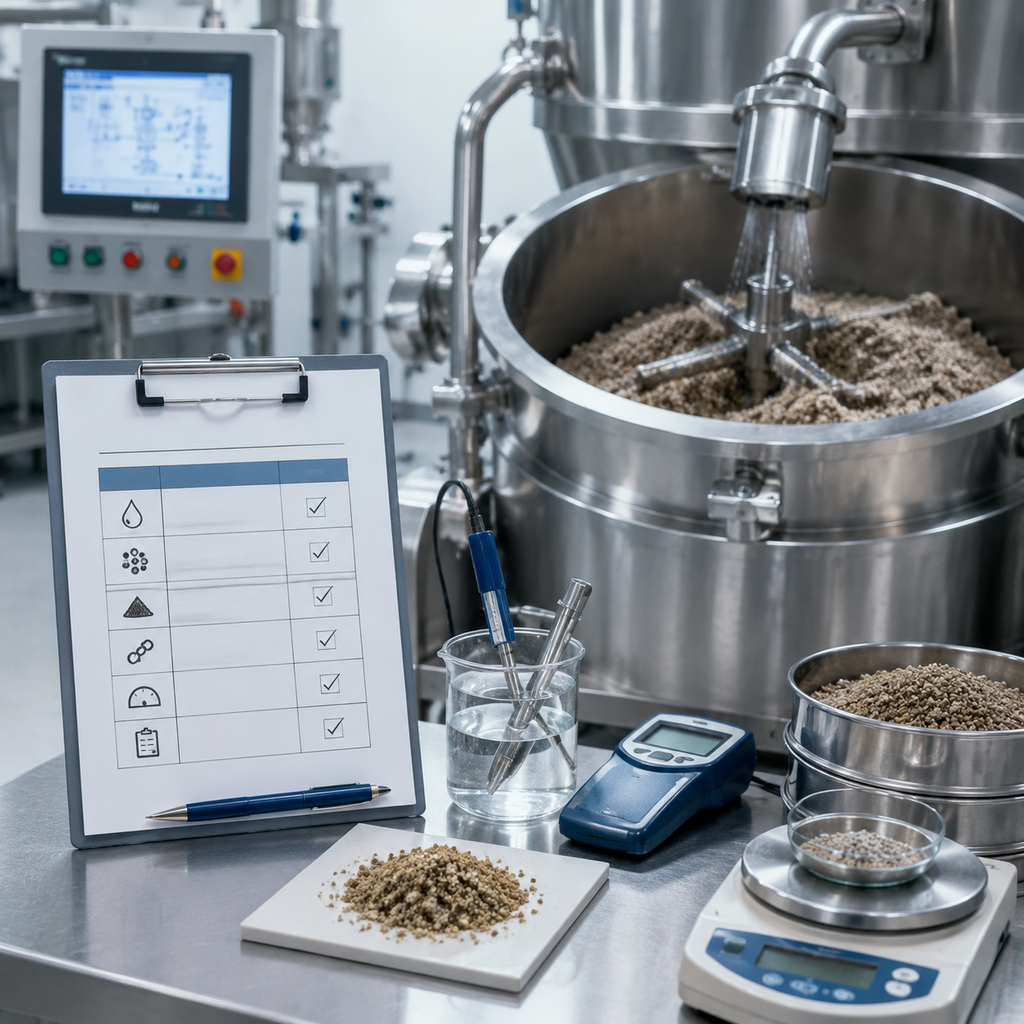
Wet-Granulation Endpoint Decisions: What Process Teams Should Measure and Record
Pharmaceutical wet granulation endpoint monitoring should be defined as a product-specific evidence package, not a universal time or speed setting. Process development, manufacturing science, QA, and equipment teams should agree which signals indicate adequate granule formation, how binder addition, torque, moisture, and sampling will be controlled, and what records prove the batch followed the approved protocol. SINOPED may be considered as an equipment example only within the scope of its public wet mixing granulator information.
What should the project define before selecting an endpoint indicator?
The project should first define what “endpoint” means for that product and process stage. In wet granulation, the endpoint typically means the point at which powder, binder solution, mixing energy, and time have produced granules suitable for the next step, commonly drying, milling, blending, or compression. The exact meaning depends on the formulation, equipment design, scale, and approved development protocol.
A useful everyday analogy is mixing dough. A baker does not judge dough only by the clock; texture, stickiness, resistance to mixing, and appearance all matter. Wet granulation is more controlled and documented, but the principle is similar: the team needs multiple signs that the material has reached the intended state.
For pharmaceutical wet granulation endpoint monitoring, buyers should avoid asking suppliers for a universal endpoint recipe. Instead, the buyer’s own quality and process owners should define the evidence required for the product. Equipment suppliers can explain available machine functions and data interfaces, but they should not replace product development decisions or site quality approval.
Which endpoint indicators should be measured and how should they be compared?
Endpoint indicators should be selected because they are relevant to the formulation and can be documented consistently. Commonly considered indicators include binder addition history, impeller or chopper behavior, torque or power trend, wet mass appearance, granule moisture, and in-process sampling observations. No single indicator is automatically sufficient for every product.
| Indicator | What it may show | Typical documentation question | Boundary to confirm |
|---|---|---|---|
| Binder addition | Whether the planned liquid amount and addition sequence were followed | Was the addition path, timing, and operator action recorded? | Depends on the approved formulation and addition method |
| Torque or power trend | Changes in wet mass resistance during mixing | Was the signal captured in a readable batch record or equipment log? | May be affected by scale, load, bowl geometry, and formulation behavior |
| Moisture assessment | Water or solvent condition of the wet mass or granules | Was the sampling location, method, and test procedure defined? | Must be linked to product-specific development evidence |
| Visual or tactile observation | Granule growth, lumping, overwetting, or dry zones | Were observation criteria trained and recorded consistently? | Subjective unless supported by defined descriptions or references |
| Sampling results | Whether material condition is representative enough for decision-making | Were samples taken from defined locations and times? | Access, safety, segregation, and cleaning requirements must be considered |
The purpose of this comparison is not to rank indicators, but to help the project define a defensible evidence set. If the endpoint decision relies on torque, for example, the team should also decide how torque is trended, whether baseline behavior is understood, and how abnormal patterns are investigated.
How should binder addition be documented without creating a fixed recipe?
Binder addition should be documented as a controlled process step, while the actual quantities, rates, and acceptance criteria must come from the buyer’s approved formulation and development protocol. The record should show what was added, how it was added, when it was added, and whether the process followed the authorized sequence.
Teams commonly need to decide whether binder is added manually, by pump, through a spray system, or by another defined method. Each option creates different evidence needs. Manual addition may require stronger operator recording and line-clearance discipline. Automated addition may require configuration records, alarm handling, and data review.
Misconception one is that the binder amount alone defines the endpoint. A more accurate view is that binder addition is only one part of the endpoint decision. Powder absorption, mixing energy, temperature, evaporation, and material variability can influence the wet mass condition.
Misconception two is that a longer wet massing time always improves granulation. In practice, additional mixing may change granule size, density, or overwetting risk depending on the formulation. The approved protocol should define how the team studies and controls this risk.
Misconception three is that operator judgment is unacceptable. Operator observation can be useful when trained, described, and documented, but it should be supported by defined criteria and, where appropriate, instrument data.
What sampling strategy should be approved before development or scale-up batches?
The sampling strategy should be approved before execution because sampling can influence both the evidence and the batch. Sampling plans typically define when samples are taken, where they are taken, how much material is removed, how tools are cleaned, and how the sample is protected before testing.
For wet granulation, representativeness is a practical challenge. Material near a wall, discharge area, spray zone, or impeller path may not behave the same way. Sampling access must also be evaluated for safety, containment, cleaning, and operator ergonomics. The team should document whether sampling is for development learning, routine batch release support, investigation, or process monitoring.
| Decision point | Question for the protocol | Record to retain |
|---|---|---|
| Sampling timing | At which process points will sampling occur? | Approved sampling schedule and actual sample time |
| Sampling location | Which locations are considered representative or intentionally diagnostic? | Sampling map, access point, and operator record |
| Sample handling | How will moisture loss, contamination, or mix-up be prevented? | Container identification and handling procedure |
| Testing method | Which test supports the endpoint decision? | Test method reference and result record |
| Deviation response | What happens if a result conflicts with another signal? | Investigation, quality decision, and batch disposition record |
Sampling should not be added casually during execution unless the approved procedure allows it. Unplanned sampling may create questions about batch integrity, data comparability, and whether the process remained inside its intended control strategy.
How should instrument configuration and equipment data be controlled?
Instrument configuration should be treated as part of the endpoint evidence system. If the team uses torque, power, speed, liquid addition records, temperature, or other machine data, the project should define how those signals are generated, displayed, stored, reviewed, and protected from unintended change.
The public SINOPED page for the GHL Series High Speed Wet Mixing Granulator may help buyers identify equipment topics to discuss, such as wet mixing granulation function and project requirements, but any endpoint monitoring requirement should be confirmed against the buyer’s own URS, quality system, and approved process protocol.
Important configuration questions include naming conventions, recipe access, alarm meanings, audit trail expectations where applicable, batch report format, time synchronization, and data export needs. Buyers should confirm what data the equipment can provide and what must be handled by site systems or separate instruments.
Equipment data should not be treated as validated process evidence unless the buyer has evaluated it under the site’s applicable procedures. Requirements for calibration, verification, electronic records, and review practices must be set by the buyer’s qualified personnel. Supplier information can support technical evaluation, but it is not a substitute for site approval.
What should the batch record capture to make the endpoint decision reviewable?
The batch record should make the endpoint decision understandable after the batch is complete. A reviewer should be able to see what criteria were expected, what actually happened, who made the decision, which data supported it, and whether any unusual event required quality assessment.
For development batches, the record often needs more explanatory detail than a routine manufacturing record because the purpose is learning. For routine production, the record should align with the approved master batch record and site documentation practices. In both cases, uncontrolled notes, missing timestamps, or unclear operator comments can weaken the evidence package.
| Record element | Why it matters | Owner typically involved |
|---|---|---|
| Approved endpoint rationale | Shows why the selected indicators are scientifically justified | Process development and QA |
| Binder addition record | Confirms the intended addition step was executed | Manufacturing and process team |
| Equipment trend data | Supports review of torque, power, time, or other configured signals | Engineering, automation, and QA |
| Sampling and test results | Links physical evidence to the endpoint decision | Manufacturing science and laboratory team |
| Deviation or observation notes | Explains unusual behavior or operator intervention | Manufacturing, QA, and process owners |
A practical rule is that the record should allow a trained reviewer to reconstruct the endpoint decision without relying on memory. If the endpoint was accepted because multiple signals aligned, the record should show that alignment. If one signal conflicted with another, the record should show how the discrepancy was evaluated.
How should scale-up change the endpoint monitoring plan?
Scale-up should trigger a deliberate review of endpoint monitoring because equipment size, geometry, fill level, impeller action, liquid distribution, and heat generation can change material behavior. A signal that was clear at small scale may become weaker, noisier, or differently timed at larger scale.
The team should not assume that a laboratory or pilot endpoint transfers directly to production. Instead, the approved scale-up protocol should define which indicators are expected to remain meaningful, which require confirmation, and how comparability will be evaluated. This is especially important when moving from development equipment to a production wet granulator or when changing bowl size, addition method, or control configuration.
Practical scale-up planning commonly includes a data comparability review, sampling feasibility check, operator training update, batch record revision, and quality review of any new or changed instrument outputs. The objective is not to force the larger process to look identical to the smaller one, but to prove that the endpoint decision remains justified for the intended product and batch scale.
How should a project define and document a wet-granulation endpoint?
A project should define the endpoint through an approved development protocol that connects product requirements, process understanding, equipment configuration, sampling strategy, and batch record evidence. The endpoint should be documented as a decision supported by data and observations, not as an isolated timer setting. Requirements must be approved by the buyer’s quality and process owners.
Can torque alone be used for pharmaceutical wet granulation endpoint monitoring?
Torque may be useful, but it should not be assumed sufficient for every formulation. Torque can reflect resistance in the wet mass, yet it may be influenced by scale, fill level, equipment design, and material properties. Buyers should confirm whether torque is a primary indicator, supporting indicator, or development-only observation under the approved protocol.
What should buyers ask equipment suppliers before relying on endpoint data?
Buyers should ask what signals the equipment can generate, how data are displayed and stored, how recipes and alarms are configured, and what documentation is available for review. They should also confirm any limits of the equipment record. The buyer remains responsible for deciding whether the data meet site quality, validation, and process requirements.
Who should approve the final endpoint criteria?
Final endpoint criteria should be approved by the buyer’s authorized quality and process owners, typically with input from manufacturing science, production, engineering, and analytical teams. Equipment suppliers can support technical discussions, but they should not approve product-specific process parameters, regulatory positions, or batch acceptance decisions for the manufacturer.
Share
Recommended Courses
Hydrogen Fuel Cell Reefer Truck

Semi Automatic KN95 Mask Making Machine
GMP Modular Clean Room System Manufacturer
Automatic Tablet Counting Machine
Recommended Solutions
GMP Modular Cleanroom Solution for a Pharmaceutical Factory in the United States
Automatic Capsule Filling Machine Project for Pharmaceutical Production in Vietnam

Softgel Encapsulation Machine Project for Pharmaceutical Laboratory Production in Iran